
Corneal Cross-Linking
At The Eye Institute of Utah, we have spent years at the leading edge of corneal care — including participating in the early clinical trials that helped bring cross-linking to patients across the country. Today, we are proud to take the next step forward: The Eye Institute of Utah is the first practice in Utah and among the first in the nation to perform Epioxa™, the newest FDA-approved generation of corneal cross-linking.
Whether you’ve recently received a keratoconus diagnosis or have been managing the condition for some time, our cornea specialists are here to help you understand what this treatment advancement means for you. Below, you’ll find everything you need to know about keratoconus, how cross-linking works, and what sets Epioxa apart.

What is Keratoconus?
The cornea is the clear, dome-shaped tissue that covers the front of the eye and plays a central role in how we see. Normally, the cornea holds a smooth, rounded shape that bends and focuses incoming light onto the retina. In keratoconus, the structural proteins that hold the cornea in shape gradually weaken, causing the cornea to thin and begin bulging forward into an irregular cone. As this happens, light can no longer focus cleanly on the retina, and vision becomes progressively distorted.
People with keratoconus often notice:
- Vision that becomes blurry or wavy and continues to worsen over time
- Increasing sensitivity to bright lights and glare
- Difficulty seeing clearly, even with an up-to-date glasses or contact lens prescription
- More frequent changes in prescription, especially astigmatism
- Halos, streaking, or ghosting around lights, particularly at night1
Keratoconus most commonly emerges in the teen years or early adulthood and may continue to progress for a decade or more. Left untreated, the cornea can reach a level of irregularity and thinning that cannot be corrected with glasses or contact lenses alone, and corneal transplant surgery may ultimately become necessary. This is why early diagnosis and timely treatment are so important: intervening before significant structural damage occurs gives patients the best chance of protecting their vision long-term.
How Does the Cross-Linking Treatment Work?
Corneal cross-linking (CXL) is a minimally invasive procedure that works by reinforcing the internal structure of the cornea at the molecular level. Using a combination of riboflavin (vitamin B2) eye drops and precisely calibrated ultraviolet (UV) light, the treatment triggers a photochemical reaction that creates new bonds between the collagen fibers running through the cornea. These additional bonds make the tissue significantly stiffer and more stable, helping it resist the ongoing thinning and forward bulging caused by keratoconus.
An important thing to understand about corneal cross-linking: the goal of the procedure is stabilization, not vision improvement. Cross-linking halts progression — it does not undo changes that have already occurred. Most patients continue wearing glasses or contact lenses after treatment. However, the impact of stopping keratoconus in its tracks is substantial. By preserving the cornea’s current shape, cross-linking helps protect the quality of vision patients have and significantly reduces the likelihood of needing a corneal transplant down the road.2
Epioxa: A New Era in Cross-Linking
For nearly a decade, the gold standard for cross-linking in the United States has been the “epi-off” approach — a proven, effective treatment, but one that requires removing the cornea’s outer protective layer (the epithelium) before riboflavin can be applied and UV light activated. While this method has helped thousands of patients stabilize their keratoconus, the removal of the epithelium means patients must endure a period of real discomfort and extended recovery as the surface of the eye heals.
Epioxa, developed by Glaukos Corporation and FDA-approved in October 2025, changes that equation. It is the first and only FDA-approved “epi-on” cross-linking therapy — meaning the epithelium is left completely intact throughout the procedure.3
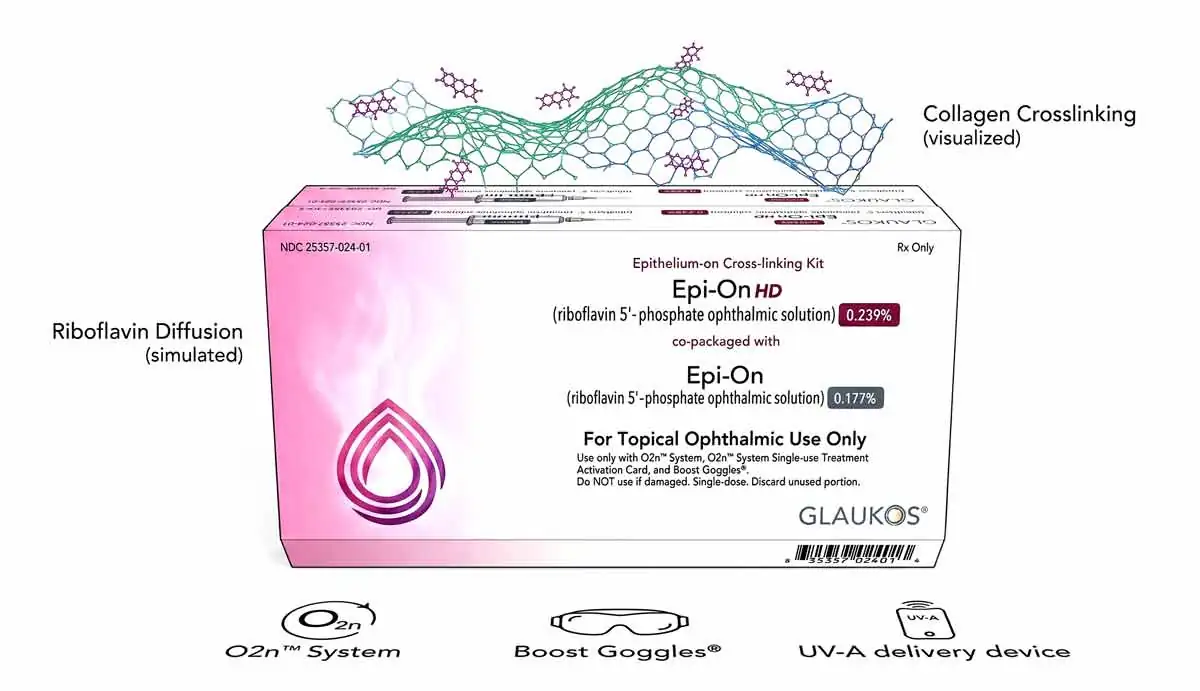
How Epioxa Achieves Epi-On Cross-Linking
The challenge with preserving the epithelium during CXL has always been penetration: the epithelium is specifically designed to protect the eye, which makes it difficult for riboflavin to pass through and reach the deeper corneal tissue where the cross-linking reaction needs to occur. Previous epi-on attempts struggled with this barrier.
Epioxa overcomes this through a proprietary, oxygen-enriched riboflavin formulation engineered to penetrate the intact epithelium in sufficient concentration. It is administered as two sequential formulations — Epioxa HD and Epioxa — followed by UV light activation using the O2n™ System and Boost Goggles®, which maintain an oxygen-rich environment essential to the cross-linking reaction.
Key Advantages of Epioxa
- Epithelium-intact: The cornea’s outer layer is preserved throughout the entire procedure — no tissue is removed
- The only FDA-approved epi-on CXL treatment: No other epithelium-on cross-linking therapy has received FDA clearance for keratoconus
- Designed for greater patient comfort: Eliminating epithelial removal means significantly less procedural and post-procedure discomfort4
- Faster recovery: With the epithelium intact, patients experience a smoother post-treatment course compared to epi-off CXL
- Backed by Phase 3 clinical trial data: Safety and efficacy were evaluated in two prospective, multicenter, randomized, placebo-controlled Phase 3 trials involving more than 400 patients5
- Approved for ages 13 and up: Eligible for adults and pediatric patients aged 13 years and older
As the first practice in Utah to offer this treatment, The Eye Institute of Utah is committed to giving our patients access to the most advanced, evidence-based care from the moment it becomes available.
Before, During, and After Your Procedure
Preparing for Your Appointment
The first step toward Epioxa cross-linking is a thorough consultation with one of our cornea specialists. During this visit, we will conduct a detailed evaluation of your corneal health, review the extent and progression of your keratoconus, and confirm whether Epioxa is the most appropriate treatment for you. You will also receive complete pre-procedure instructions and have plenty of time to ask any questions.
Please arrange for a driver to bring you home after your procedure, as you will not be able to drive immediately following treatment.
What Happens During the Procedure
Epioxa is performed as an outpatient procedure under topical anesthesia — numbing eye drops are applied to keep you comfortable. The procedure involves sequentially applying two riboflavin formulations to the surface of the eye. UV light is then used to activate the cross-linking reaction within an oxygen-enriched environment maintained by the O2n™ System and Boost Goggles®. There is no incision and no removal of corneal tissue.
If both eyes require treatment, we treat them in separate sessions to allow for proper recovery between procedures.
Recovery and Follow-Up
Because Epioxa leaves the epithelium intact, recovery is generally faster and more comfortable than with traditional epi-off cross-linking. You may notice some mild light sensitivity or temporary fluctuations in vision in the days following treatment — this is normal and expected to resolve as the eye settles.
You will receive prescriptions for antibiotic and steroid eye drops to support healing and prevent infection. Avoid rubbing your eyes and keep the treated eye free from water, sweat, and makeup for the first several days. Your care team will schedule follow-up visits to monitor your progress and confirm that the cornea is responding as expected.
Keep in mind that cross-linking’s full effect builds gradually. Continued corneal strengthening takes place over the months following the procedure, and follow-up imaging helps us track that stabilization over time.
Who is a Candidate for Epioxa Cross-Linking?
Epioxa may be the right treatment for you if:
- You have been diagnosed with progressive keratoconus
- You are 13 years of age or older
- Your keratoconus is in the mild to moderate stage
- Your vision has been worsening or has become increasingly difficult to correct with glasses or contact lenses
Candidacy is determined through a comprehensive eye examination and one-on-one consultation. Our team will review the stage of your condition, your corneal measurements, and your overall ocular health to determine whether Epioxa is appropriate for your case. If it isn’t, we will discuss other options that may be right for you.
If you’ve been diagnosed with keratoconus, or if you’ve noticed your vision changing in ways that feel hard to explain, we encourage you not to wait. The earlier keratoconus is caught and treated, the more effectively we can protect your vision.
FAQs About Epioxa and Corneal Cross-Linking
How is Epioxa different from the cross-linking EIU has offered in the past?
The previous FDA-approved cross-linking treatment used what is called an “epi-off” approach, which required the corneal epithelium — the eye’s outer surface layer — to be removed before riboflavin drops could be applied. Epioxa is an “epi-on” treatment: a specially engineered, oxygen-enriched riboflavin formulation allows the treatment to penetrate the cornea without removing the epithelium. The result is a procedure designed to produce clinically meaningful outcomes with significantly less discomfort and a faster recovery.
Will Epioxa improve my vision?
Epioxa is designed to stabilize the cornea and stop keratoconus from worsening — not to improve or correct vision that has already been affected. Most patients continue to use glasses or contact lenses after treatment. That said, successfully halting the progression of keratoconus is a meaningful outcome: it protects the level of vision you have and substantially reduces the risk of needing more invasive treatment, such as a corneal transplant, in the future.
Is the procedure painful?
Numbing drops are used throughout the procedure to keep you comfortable. Because Epioxa does not require removing the epithelium, the post-procedure discomfort that is common with traditional epi-off cross-linking is significantly reduced. Some mild light sensitivity or irritation during recovery is normal, and our team will provide guidance on managing any symptoms.
Can both eyes be treated in the same visit?
No. If both eyes require treatment, procedures are scheduled separately to allow one eye to recover before the other is treated.
How long does recovery take?
Recovery with Epioxa is generally more comfortable and faster than with traditional epi-off cross-linking, because the corneal surface does not need to regenerate. Most patients return to normal daily activities relatively quickly. Full corneal stabilization, however, continues to develop over the months that follow treatment — your follow-up schedule with our team will help monitor that progress.
Will my insurance cover this?
Coverage for corneal cross-linking varies by insurance plan and is typically based on medical necessity. Many plans do cover the procedure when it is warranted by progressive keratoconus. Our team can help you verify your benefits prior to your consultation and will work with you to understand your options for coverage or financing.
What if I’m not a candidate for Epioxa?
Not every patient will be a candidate for Epioxa, and that’s why a thorough consultation is the essential first step. If Epioxa is not the right fit for your situation, our cornea specialists will discuss other available treatment options and work with you to develop a plan that best serves your vision health.
Does the appearance of my eyes change after treatment?
No. Corneal cross-linking — including Epioxa — strengthens the internal structure of the cornea without any visible change to the outward appearance of your eye.
Ready to Learn More?
If you have questions about keratoconus or want to find out whether Epioxa cross-linking is right for you, our team is here to help. The Eye Institute of Utah is proud to bring this treatment milestone to patients in Utah — schedule a consultation with our cornea specialists today.
 Sources
1American Academy of Ophthalmology. What is Keratoconus? Available: https://www.aao.org/eye-health/diseases/what-is-keratoconus. Accessed May 7, 2026.
2Belin MW, Lim L, Rajpal RK, Hafezi F, Gomes JAP, Cochener B. Corneal Cross-Linking: Current USA Status: Report From the Cornea Society. Cornea. 2018 Oct;37(10):1218-1225. doi: 10.1097/ICO.0000000000001707. Erratum in: Cornea. 2019 Oct;38(10):e49. doi: 10.1097/ICO.0000000000001901. PMID: 30067537. Available: https://pubmed.ncbi.nlm.nih.gov/30067537/. Accessed May 7, 2026.
3Glaukos Corporation. Glaukos announces FDA Approval of Epioxa. October 20, 2025. Available: https://investors.glaukos.com/news/news-details/2025/Glaukos-Announces-FDA-Approval-of-Epioxa/default.aspx. Accessed May 7, 2026.
4Eyes on Eyecare. FDA Approves Glaukos’ Epioxa Corneal CXL Therapy. October 20, 2025. Available: https://glance.eyesoneyecare.com/stories/2025-10-20/fda-approves-to-glaukos-epioxa-cxl-ilink-therapy/. Accessed May 7, 2026.
5Glaukos Corporation. Glaukos announces FDA Approval of Epioxa. October 20, 2025. Available: https://investors.glaukos.com/news/news-details/2025/Glaukos-Announces-FDA-Approval-of-Epioxa/default.aspx. Accessed May 7, 2026.
Page Updated:
The Eye Institute of Utah Doctors have either authored or reviewed and approved this content.